
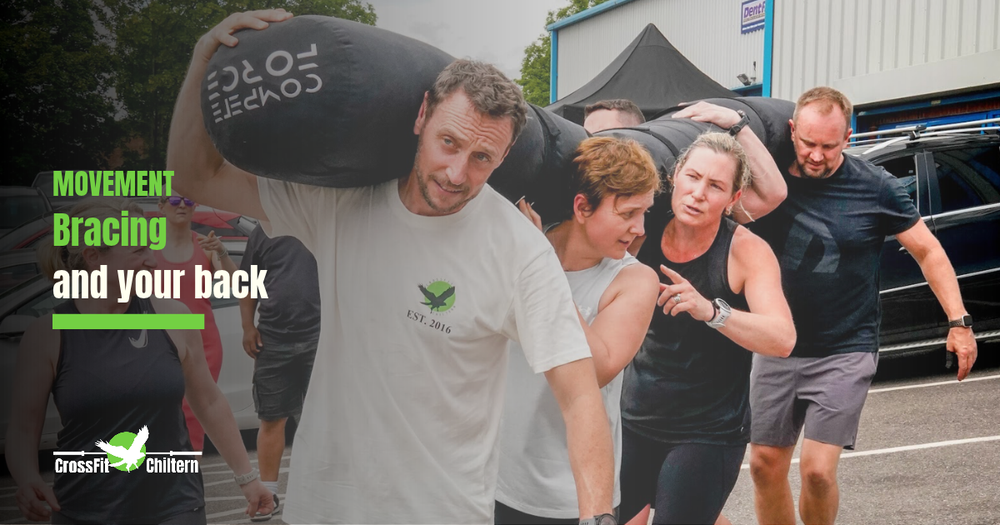
We call this midline stabilisation. Picture a line down your side that trisects the spine and bisects the pelvis. Bracing is holding the natural S-curve of that spine and keeping it wedded to the pelvis while you move under load.
It is not a stomach exercise. Bracing is the whole trunk switching on at once — front, sides and back together. Pulling the belly button towards the spine belongs to a different school and we do not teach it.
Take a breath into your stomach, not your chest, and tighten everything around it as though you were about to be punched in the stomach. The breath is the point: air in the abdomen under tension raises the pressure inside it, and that pressure is what stiffens the column your limbs are working against. A big breath into the chest with a soft middle underneath gives you none of the support.
For a heavy single, breathe, brace, complete the rep, breathe at the top. For a set of fifteen you cannot hold it and should not try — breathe at the top of each rep and keep the tension underneath the breath.
Where it shows is the deadlift, the front rack, and anything overhead. The brace keeps your spine stacked, and it is essential to protecting your back under load. It is also what a lifting belt is for — not a back support, but something to brace against.
Speak to a coach about how to brace. It is one of the most important things to learn in lifting.
Sources: CrossFit Common Movement Themes — Midline Stability — https://www.crossfit.com/pro-coach/common-movement-themes-midline-stability · Midline Stability, Part 1 — https://www.crossfit.com/essentials/midline-stabilization-part-1